

Temporary Vacation
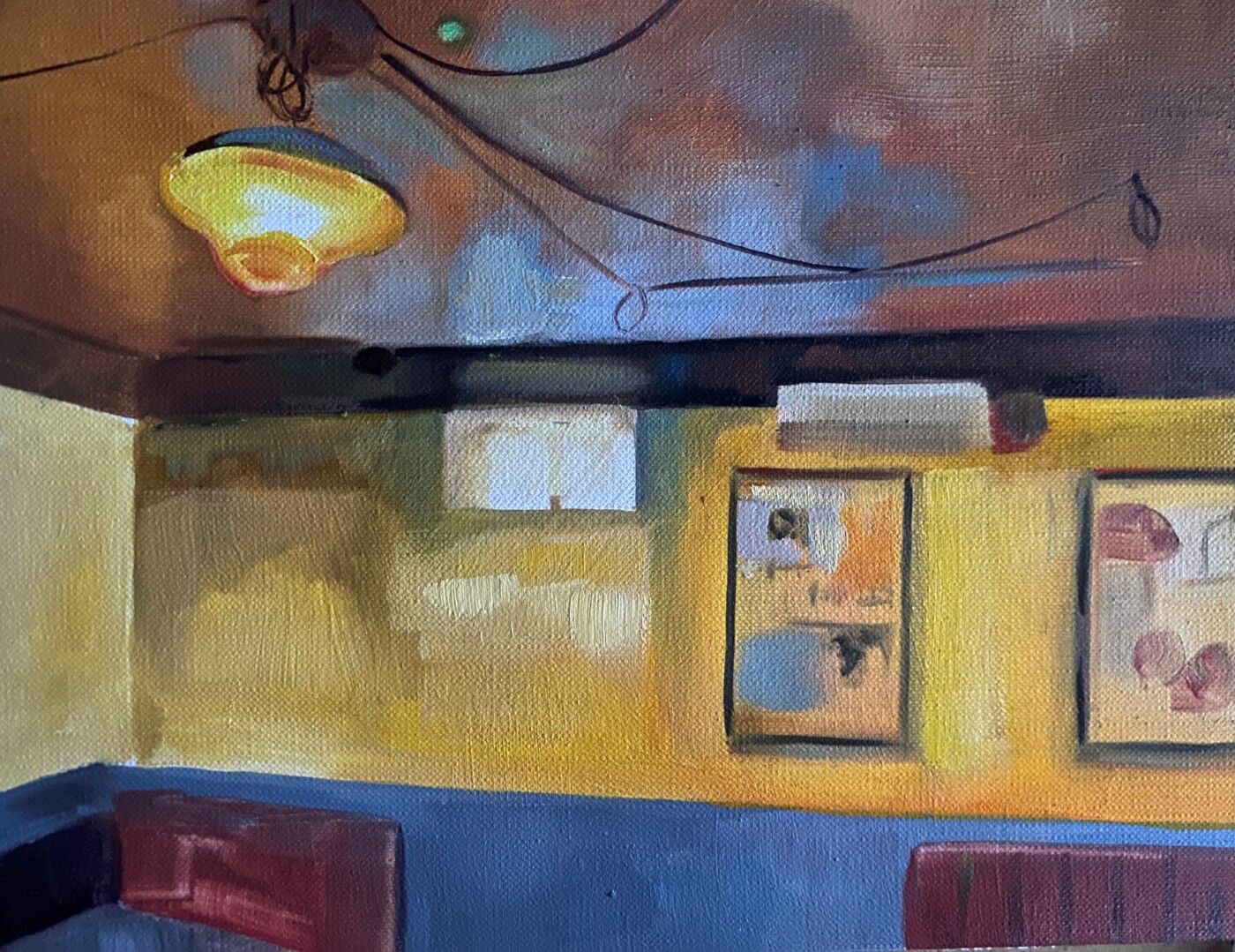
This exhibition brings together a compelling body of work by contemporary painter Mary Cullen Kelly, exploring the quiet, resonant psychology of unpeopled spaces. By completely removing the human figure from her canvases, Kelly shifts the burden of narrative onto the everyday architecture, domestic interiors, and object arrangements left behind. What emerges is not a void, but a profound commentary on the landscape of modern isolation, hyper-individualism, and the silent spaces that define our contemporary lives. Through these distinct oil paintings, Kelly invites the viewer to step into the role of the missing protagonist, turning passive observation into an active haunting.
The exhibition unfolds across three distinct spatial inquiries: the public void, the domestic silhouette, and the distilled relic. In the first phase, Kelly captures the unsettling stillness of shared social environments. One canvas pulls the eye upward into an industrial ceiling wrapped in toxic, burning ochres and bruised purples, while another isolates an empty restaurant booth bathed in the synthetic glare of an electric wall lamp. These spaces, typically buzzing with human traffic, are frozen in a state of suspended animation. They mimic the paradox of our deeply connected yet profoundly lonely urban existence – spaces we frequent together yet experience entirely alone.
As the viewer moves deeper into the exhibition, the scale shifts toward the domestic phantom. Kelly’s interior home scenes – a vacant staircase overlooked by a dim mirror, or a lone tufted armchair swallowed by dramatic, cold shadows beneath a brilliant ceiling fixture – evoking a distinct sense of displacement. Here, light does not comfort; instead, it cuts across the rooms in sharp, geometric beams, isolating furniture like artifacts in a museum of the lonely. The furniture retains the memory patterns of bodies that once occupied them, forcing a contemporary audience to confront the quiet echoes of their own solitary domestic lives.
Finally, the narrative is distilled down to its core in the anchoring still life, which appears as a collection of highly individual, brightly patterned glass and ceramic vessels sitting tightly clustered on a saturated orange table. In the total absence of characters, these objects stand as surrogate selves. Their isolated placement, trapped against an impenetrable, monolithic grey backdrop. This speaks directly to the modern condition: we are more pristine and decorated, self-contained, and visible than ever before, yet profoundly compartmentalized from one another.
Kelly’s colour palette operates as the emotional engine of this collection. The jarring friction between cold, ambient shadows and intense, synthetic blocks of colour captures the exact frequency of modern life – a world glowing brightly with simulated connection, yet deeply anchored in a beautiful, quiet solitude. Ultimately, Temporary Vacation is a departure that challenges the traditional structures of visual storytelling, perhaps in response to growing geopolitical anxieties or as a reflection to perceived shifts in how we relate to our own reality in a post covid landscape, whatever the reasons, Kelly suggests that the true contemporary narrative is not found in what we do or who we are with, but in the silent, glowing rooms we inhabit, and the precious, solitary things we choose to leave behind, and the strange angles we choose to see them.